

Does a Big Poker Pot Mean You Have to Call?

A big poker pot can make folding feel like abandoning a decision already made. Yet every new bet creates another choice. The chips in the middle affect the price of continuing, but the amount you personally contributed does not oblige you to add more. “Pot committed” is useful only when it describes the relationship between the remaining call and the hand’s prospects. It shouldn't encourage you to keep playing when a fold would be wiser.
In a Psychology Today interview, Annie Duke describes the sunk cost fallacy as allowing resources already spent to influence whether we commit further resources. Your earlier contributions helped build the pot, but they do not remain a separate pile belonging to you. Calling again is a new decision involving the chips still in your stack.
The pot and the price are different numbers
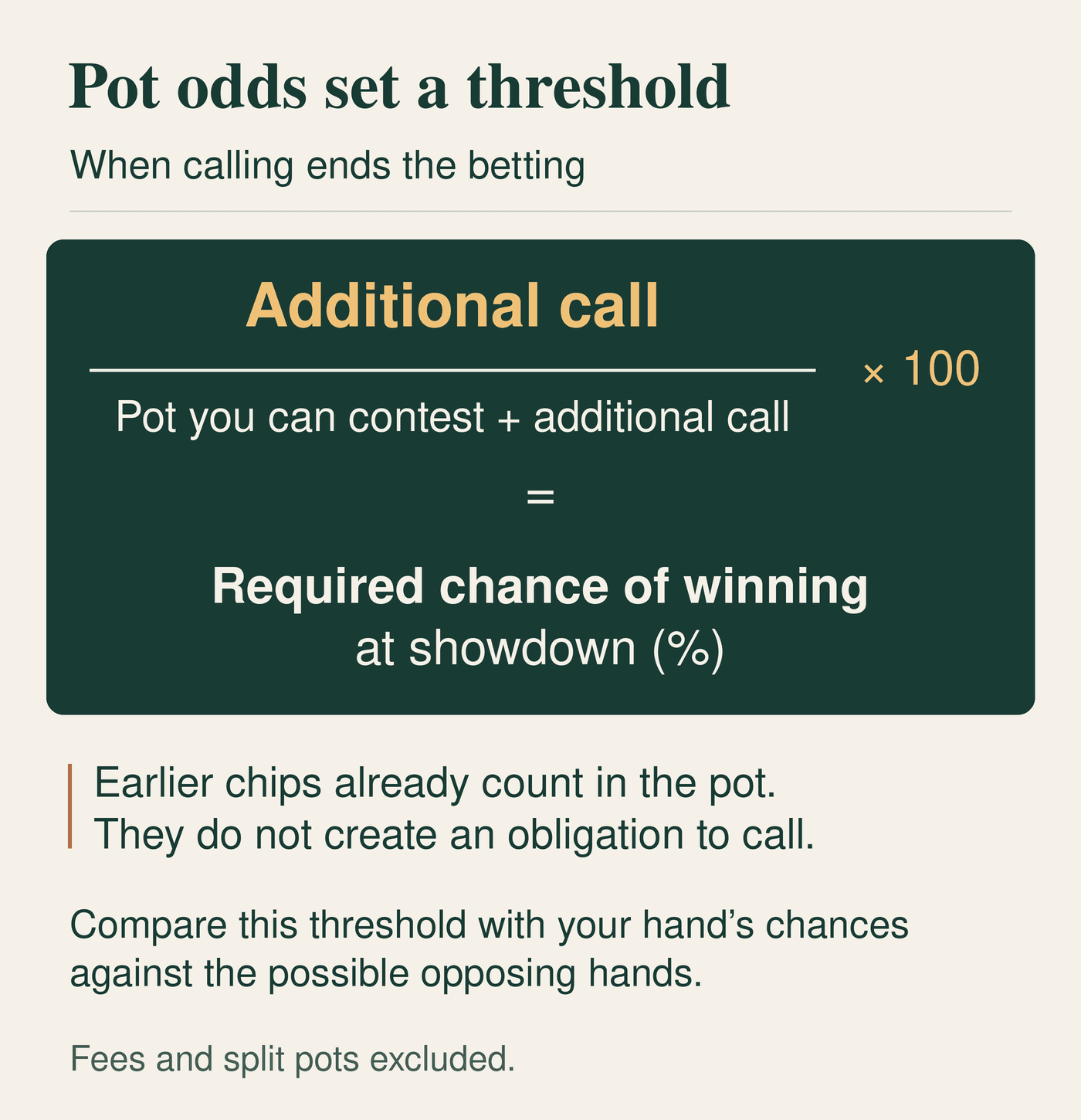
Start with the pot you can contest and the additional amount needed to call. Pot odds express the relationship between those amounts. Holding the call amount constant, a larger pot gives a better price. Holding the pot constant, a larger call gives a worse one. Neither calculation asks who supplied the earlier chips. Their presence matters; their origin does not create an extra reason to continue.
For a final call with no further betting, divide the additional call by the pot after that call, then multiply by 100. Ignoring fees and split pots, the result is the minimum percentage chance of having the best hand at showdown needed to justify calling on pot odds alone. Use the additional chips needed now, not everything you contributed throughout the hand, including earlier calls and raises. Estimating whether your hand meets that threshold is a separate task.
During an online cash hand on Ignition Poker, the relevant comparison is between the current calling price and what the available information suggests about your hand. A large pot can justify considering a call with a hand that would not warrant the same commitment into a smaller pot. It cannot establish that the hand is strong enough by itself. You still need to consider the board and the hands your opponents could reasonably hold.
Several opposing hands may fit the betting so far. Being behind some of them does not automatically settle the decision, just as receiving an attractive price does not automatically settle it in favor of calling. If no plausible opposing holding can be beaten or tied at showdown, a larger pot cannot make your cards stronger.
The phrase “pot committed” often arises when little of a player’s stack remains compared with the pot. That limits how much more they can put in and may leave them facing an attractive calling price. Whether continuing is justified still depends on their cards and the possible opposing hands.
Check what can happen after your call
The simplest comparison occurs when calling closes the betting and takes the hand directly to showdown. There is no later wager to consider. Earlier in a hand, calling may only take you to the next betting round, where another decision awaits.
An all-in bet does not always remove that complication. In a multiway pot, meaning one involving more than two players, other participants may still have chips and the ability to raise. Identify who remains to act before treating the amount currently facing you as the final price.
Another caller also changes more than the pot size. Their chips can improve your immediate calling price, while their continued participation adds another hand to consider. More chips in the middle do not tell you whether your cards compare favorably with everyone still involved.
What a commentator’s prediction actually tells you
In Xuan Liu’s narrated poker hand, she describes a multiway pot and expects a player holding top pair to continue because so much is already in the middle. She also discusses whether he might raise instead of calling, potentially pushing another player out.
That is a prediction about how someone will respond to the situation. It is not, by itself, a calculation establishing the correct action. Calling and raising would leave different possibilities for the players still involved.
Liu also connects her reasoning about a shorter stack to token status during a Squid round. Her assessment includes conditions beyond the main pot. That token-related reasoning belongs to the particular format she is discussing; it does not turn a small remaining stack into a general instruction to call.
Understand a call before copying it
Watching someone explain a decision and repeating their action are different activities. A 2025 laboratory study of observational learning found in exploratory analyses that participants who preferred consistent, higher-performing simulated partners tended to rely more on imitating their choices. The experiment did not test poker play or establish which calls are correct, but it's still useful for understanding how we might approach this kind of game.
At the table, another player may hold different cards and face a different calling price. Their call gives you information about their decision; it does not make your choice for you. A narrated hand is most useful when the explanation preserves those differences.
Before calling, establish the additional cost, consider the opposing hands, and check whether further betting remains possible. A player can be willing to call one amount and fold to a larger raise in the same hand. The earlier call does not commit them to every later price.

